

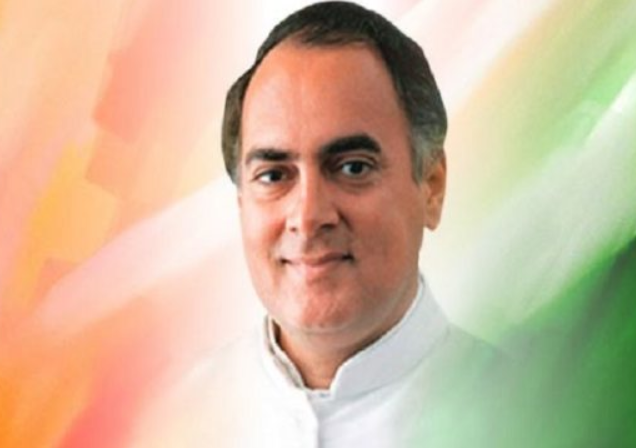
Remembering the late former Prime Minister of India Rajiv Gandhi on his 74th birth anniversary.
Yesterday marked the 74th birth anniversary of the late former prime minister of India Rajiv Gandhi. Let’s have a glimpse of the short yet effective lifespan of one of the most dynamic and youthful Prime Ministers of India.
Born in the year 1944, Rajiv Gandhi, the elder son of the former prime minister of India Indira Gandhi, never wanted to enter into politics. He was living a very happy life with his Italian wife Sonia Gandhi as a pilot in Indian Airlines. It was the untimely death of his younger brother Sanjay Gandhi, who was actively involved into politics playing a major role in influencing the policies of Indira Gandhi government, which catapulted him into Indian politics as a successor of his mother, the then prime minister of India, Indira Gandhi.
He was made the General Secretary of Congress party and was elected to the lower house of parliament from Amethi—the constituency of his younger brother Sanjay Gandhi. In 1982, he was entrusted with the responsibility of organizing the Asian Games in New Delhi.
In 1984, after his mother Indira Gandhi got assassinated her Sikh bodyguards, the Congress party proposed his name as the next prime minister of India. The Lok Sabha was dissolved before the completion of its full term, and the General elections of the Lok Sabha were held right after that in which Congress party emerged as the largest party with an unprecedented majority with the help of sympathy vote in the wake of Indira Gandhi’s murder.
In response to the “1984 Sikh riots”, which were caused due to the assassination of Indira Gandhi her Sikh bodyguards, his remark—“Whenever a big tree falls down, it’s very obvious of the earth around it to shake” drew a spate of criticism with many considering it as a ‘virtual justification’ of the riots which had claimed the lives of tens and hundreds of people.
Out of many contributions as the prime minister of India, one thing which stood out the most was his contribution towards information and technology. People still fondly recall his tenure as the one which brought the computers to India. The anti-defection law, which prevents the legislators form switching from one party to another and curbs the political opportunism and corruption, was introduced under his regime in 1985.
He founded the Jawahar Navodaya Vidyalaya system, which is a Central government-based education institution that provides rural populations with free residential education from grades six to twelve IN 1986. It was under tenure that the voting age for the election of Lok Sabha and Legislative assembly was reduced to 18 form 21.
The decision of his government to nullify the judgment of Supreme Court in the infamous Shah Bano Case, which was brought out to appease the minorities, drew a lot of criticism. Further, as the allegation of Bofors scandal were levelled against him, his corruption-free image also went for a toss. The peacekeeping force he had sent to Sri Lanka in 1987 to help the Sri Lankan government quash the demands of Sri Lankan Tamils for a separate nation antagonized the Tamils at home. As a result of which, In 1991, during a campaign for election, he was killed suicide bombers in Tamil Nadu the members of LTTE.

Currently, I am pursuing B.A(H) Political science from Satyawati College, Delhi University.
I like public speaking, writing and reading in my leisure.


